Businesses looking to outsource are faced with the task of identifying a suitable outsourcing partner. All of them will promise drastic cost savings and smooth workflows. But not all will deliver on their claims.
So how do you separate real partners from polished sales pitches in practice? And once you’ve done so, how do you ensure that a BPO partner is doing what it should do for you?
This guide walks you through everything you need to know about how to choose the right outsourcing partner: the types of services available, the green flags to look for, the red flags to avoid, and the questions every smart buyer should ask before signing a contract.
The factor most buyers miss when choosing outsourcing partners
Most outsourcing decisions underperform for a simple reason: buyers overlook one critical question. How does this company treat its own people?
There’s a direct line between how a BPO cares for its agents and the quality of service your customers receive.
Happy, tenured agents who feel valued don’t just perform better. They stay longer, build deeper product knowledge, and bring genuine warmth to every customer interaction. High attrition, on the other hand, means your support team is perpetually in rebuild mode, and your customers feel every handoff.
When evaluating potential partners, look at their website and social media pages. Check how they talk about their agents and their company culture. That will clue you into how they operate.
Services and Solutions Offered by Outsourcing Partners
Outsourcing providers don’t all offer the same thing. Here are the most common models used by outsourcing companies.
Employer of Record (EOR)
An Employer of Record arrangement allows you to hire and employ workers through an outsourcer. The outsourcer in this case is the Employer of Record. The EOR handles payroll, taxes, and benefits, and makes sure you stay compliant with the laws of country your employee is in. This is especially useful if you want to hire from countries where you don’t have a legal entity.
You still manage day-to-day operations and control the talent, but the EOR takes care of the legal aspect and HR tasks.
Staff Augmentation
Staff augmentation is a popular model that lets you hire skilled staff temporarily to fill in gaps in manpower or expertise. These staff members become part of your in-house team for the duration of their contract. Meanwhile, you are in charge of managing them, just as you would your in-house employees.
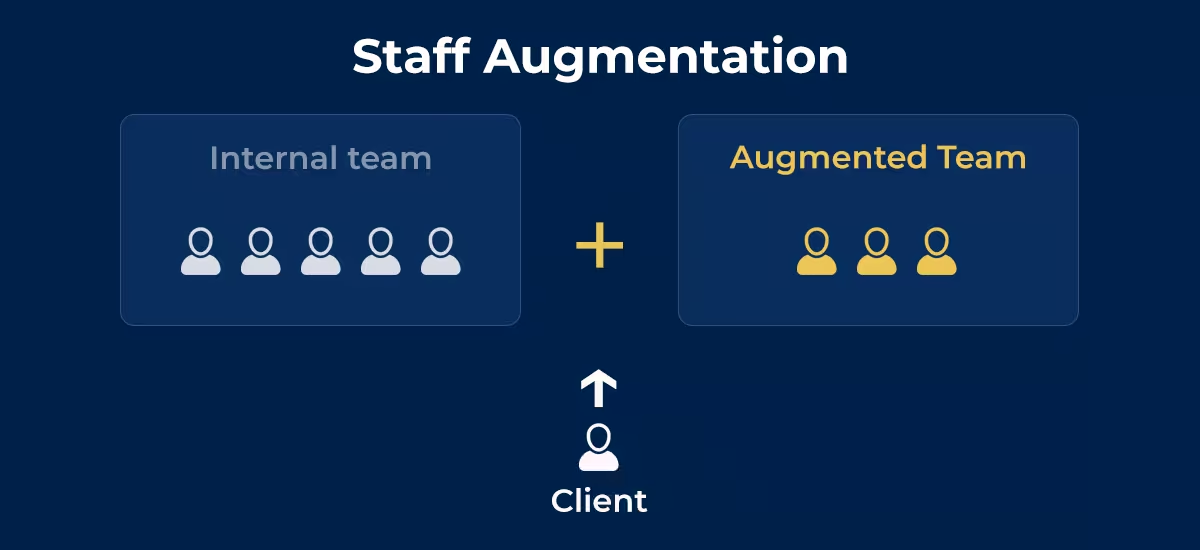
This model is ideal for customer support, technical roles, and any function where you need extra horsepower without committing to permanent headcount.
Managed Teams
With a managed team model, the outsourcing provider takes ownership of an entire function. As the term suggests, the provider manages the team for you, including recruitment and training. They become like an extension of your business. You can be more hands-off with day-to-day management.
This model is ideal for customer support, back-office support, or technical support–departments where clients want results without the burden of managing.
The strongest managed team providers are built around retention, not just staffing. When agents are happy in their roles, they stay. A stable, low-attrition team doesn’t need to be constantly rebuilt.
That continuity is what allows a managed team to truly become an extension of your brand rather than a revolving door of unfamiliar faces.
How to Ensure Outsourcing Success
Finding an outsourcing partner is easy. Finding one you can actually trust with your business is harder. The difference comes down to how you evaluate them.
Look for Transparent Pricing

Pricing opacity is one of the biggest pain points in outsourcing. Hidden fees, mandatory minimums, and vague contract terms can turn a seemingly affordable deal into an expensive lesson.
The ideal partner will give you clear, itemized pricing from the start. They won’t require you to commit to a minimum number of seats or a minimum spend.
When talking to providers, ask for a full breakdown of what’s included: onboarding, training, management overhead, technology, and any potential add-ons. If a provider is vague or evasive about pricing, that’s a signal worth paying attention to.
Ask About Data Protection
When you outsource, you’re sharing access to some of your most sensitive assets: customer data, internal systems, and proprietary workflows. A reputable outsourcing partner takes data security seriously and can demonstrate it.
Ask about their compliance certifications (ISO 27001, SOC 2, GDPR, HIPAA as applicable), their data handling policies, and how they protect information at rest and in transit.
Ask how they manage access controls, what happens to data when the contract ends, and whether they carry cyber liability insurance. Clear, confident answers here are non-negotiable.
Vet Their Company Culture

The best outsourcing partnerships feel like extensions of your own team. That only happens when there’s genuine cultural alignment.
Spend time understanding how a potential partner runs their organization. Do they share your values around customer experience, communication, and accountability? Are they transparent when things go wrong, or do they deflect?
Ask for references from long-term clients. Look at their online reviews and social media presence. Request a walkthrough of how they handle quality issues or service failures.
Culture is hard to fake over time, and a misaligned partner will make your customers feel it.
Ask and Research About Employee Experience
This is often the deciding factor between average outcomes and exceptional ones, yet it is frequently overlooked.
The quality of your outsourced customer experience is a direct reflection of how that BPO treats its agents. When agents feel supported, fairly compensated, and invested in, they show up differently.
They’re more patient and engaged. They’re more motivated to solve problems rather than just close tickets. That energy is felt in every customer interaction, even over chat and email.
Equally important is the impact on attrition. High turnover is one of the most damaging and least discussed problems in outsourcing.
When agents constantly cycle in and out, your support team never builds real product knowledge or customer familiarity.
New agents make more mistakes, take longer to resolve issues, and can’t pick up on the nuances that long-tenured agents handle instinctively.

Low attrition, by contrast, creates continuity. Agents who stay longer become genuine experts in your product, your tone, and your customers. They require less oversight and produce more consistent outcomes.
In strong models, the team you build early continues to evolve with you over time rather than being constantly replaced. That stability compounds over time.
When evaluating an outsourcing partner, ask:
- What is your average agent tenure?
- What does your benefits and career development program look like?
- How do you collect and act on agent feedback?
- How do you measure agent satisfaction?
A provider who can answer these questions confidently and backs them up with data is one who understands that great customer experience starts from the inside out.
What Are Some Signs of a Bad Outsourcing Partner?
Knowing what to look for in a great partner is only half the equation. Here are warning signs that should make you walk away:
- Rigid minimums and long lock-in contracts with no flexibility to scale up or down without penalties
- Vague or evasive answers about pricing, including surprise fees that appear after signing
- No clear data security policies, or difficulty producing compliance documentation
- High agent attrition. A revolving door of staff means your customers are constantly dealing with someone new who doesn’t know your product, your tone, or your history
- No visible investment in employee well-being, career development, or agent satisfaction. The quality of your customer experience is only as strong as the people delivering it
- Overpromising during the sales process without references or case studies to back it up
- Poor communication and responsiveness. If they’re slow before you’re a client, it won’t get better after
- One-size-fits-all solutions with no ability to customize to your business needs
- No SLAs or unwillingness to commit to measurable performance standards
- Lack of transparency about where your team is located or how they’re managed day-to-day
Pay attention early. A partner who makes you feel like a number during the sales process will likely treat your customers the same way.
Ready to Find the Right Fit?
Choosing the right outsourcing partner is one of the most important decisions you’ll make for your business. Take your time, ask the hard questions, and look for a partner who treats your business with the same care they’d want for their own.
We built our model around two beliefs: that outsourcing should be accessible to businesses of all sizes — which is why we do not require minimum seat counts or long-term lock-ins — and that great customer experience starts with great employee experience.
Our agents aren’t just trained; they’re intentionally hired, supported, and retained so they can become true extensions of your team. That’s what makes the difference between a support team that processes tickets and one that actually wins your customers over. Whether you need two agents or two hundred, our structure flexes around your business, not the other way around.
Frequently Asked Questions
What is an outsourcing partner?
An outsourcing partner is a third-party company you engage to manage specific business functions (such as customer support, IT, or back-office operations) on your behalf. Unlike a generic vendor, a true outsourcing partner aligns with your goals and operates as an extension of your team.
What are the types of outsourcing?
Outsourcing can be categorized in several ways, depending on the function and the structure of the engagement. Common functional categories include professional outsourcing, such as legal, accounting, and marketing, IT outsourcing, including software development, infrastructure, and technical support, Business Process Outsourcing, or BPO, such as customer service, HR, and data entry, and manufacturing outsourcing, including production and assembly.
In practice, many buyers also evaluate outsourcing based on engagement models, such as staff augmentation, Employer of Record arrangements, or fully managed teams. The right approach depends on how much control, flexibility, and operational support your business needs.
How do you find the right outsourcing partners?
Start by clearly defining your needs, then research specialized providers through referrals, review platforms like Clutch or G2, and structured RFP processes. Always ask for references, and where possible, run a pilot before committing to a full engagement.
Is outsourcing illegal in the USA?
No, outsourcing is entirely legal in the United States for both domestic and international arrangements. However, it is important to ensure compliance with relevant regulations around worker classification, data privacy (CCPA, HIPAA, where applicable), and any industry-specific requirements. A reputable outsourcing partner will help you navigate these.