So you’re thinking of outsourcing from the Philippines and wondering if it’s actually worth it. Is the hype real? Is it still a good choice in 2026?
The short answer?
Yes. The Philippines, with its mix of high English fluency, hospitality, and Western culture fit, is undeniably a great choice for outsourcing. However, the quality of the talent you hire from the Philippines or any country comes down to the BPO provider you work with.
A good provider will be transparent about pricing, cultivate a great remote working environment, and take care of the legalities you need to comply with to get your business up and running.
But before we get into the details, let’s talk about why the Philippines made a name in outsourcing: its people.
The demographics of the Philippines contribute a lot to its status on the global stage.
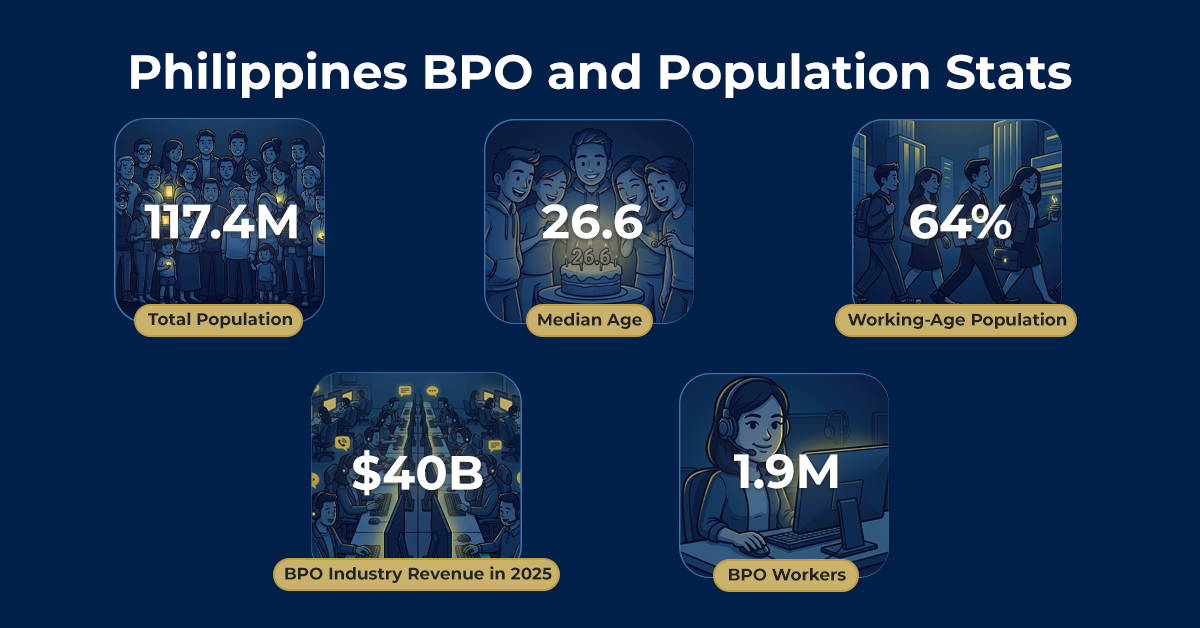
For one, did you know that the Philippines has a young and growing population? The total Philippine population in 2025 was 116.8 million and ranks 14th in the world in population size.
More than half of its people are of working age (defined as anywhere between 15 to 64 years old).
That means there is a near-endless well of talent to draw from when picking the Philippines as your outsourcing destination and that well won’t dry up anytime soon.
However, that being said, you still need to weigh the potential trade-offs before signing on the dotted line.
So, what factors do you need to consider when deciding to hire from the Philippines?
In this article, I’ll talk about the pros and cons of outsourcing to the Philippines, plus give you tips on how to select the right BPO provider for you.
I hope this guide helps you understand the benefits and risks of BPO outsourcing to the Philippines so you can hire top talent that fits your business. Let’s get started.
Getting to Know the Philippines BPO Industry
The Philippines is undoubtedly one of the most popular outsourcing countries in the world and perhaps even the global epicenter of BPO.
To give a quick primer, the BPO industry in the Philippines started in 1997 when the first multinational call center set up business in the country.
Then, the 1995 Special Economic Zone Act attracted more investors because of the tax incentives and lower area requirements it provided. Shortly after, other call centers followed suit.
In 2010, the country was hailed as the global epicenter of BPO.
More than fifteen years later, the Philippine outsourcing industry is thriving despite the entry of outsourcing alternatives like Latin America and South Asia.
BPO industry revenue in the Philippines is expected to increase to $61B by 2030 and generate 969,000 skilled jobs in that same timeframe.
Accounts BPO Companies Have in the Philippines
The most common accounts BPO companies have in the Philippines are:
- Inbound calls: finance and accounting, customer hotlines, technical support, after-sales, and administrative coordination
- Outbound calls: lead generation, sales calls
- Chat and email support
- Back office
- Retail outsourcing
- Human resource management
- Travel management
- Payroll services
- Banking and finance
Pros of Outsourcing to the Philippines
Lower Costs
The first and most obvious advantage of Philippine outsourcing is cost-efficiency. You will save a lot on labor costs by hiring Filipino talent, compared to hiring onshore.
That’s because labor costs are low in the Philippines, even when you compare them to its Asian neighbors.
To be more specific, the daily minimum wage in the Philippines for the BPO sector is $11.27. The monthly salary of a Filipino worker can range from $269 to $612, though this can increase depending on experience and seniority.
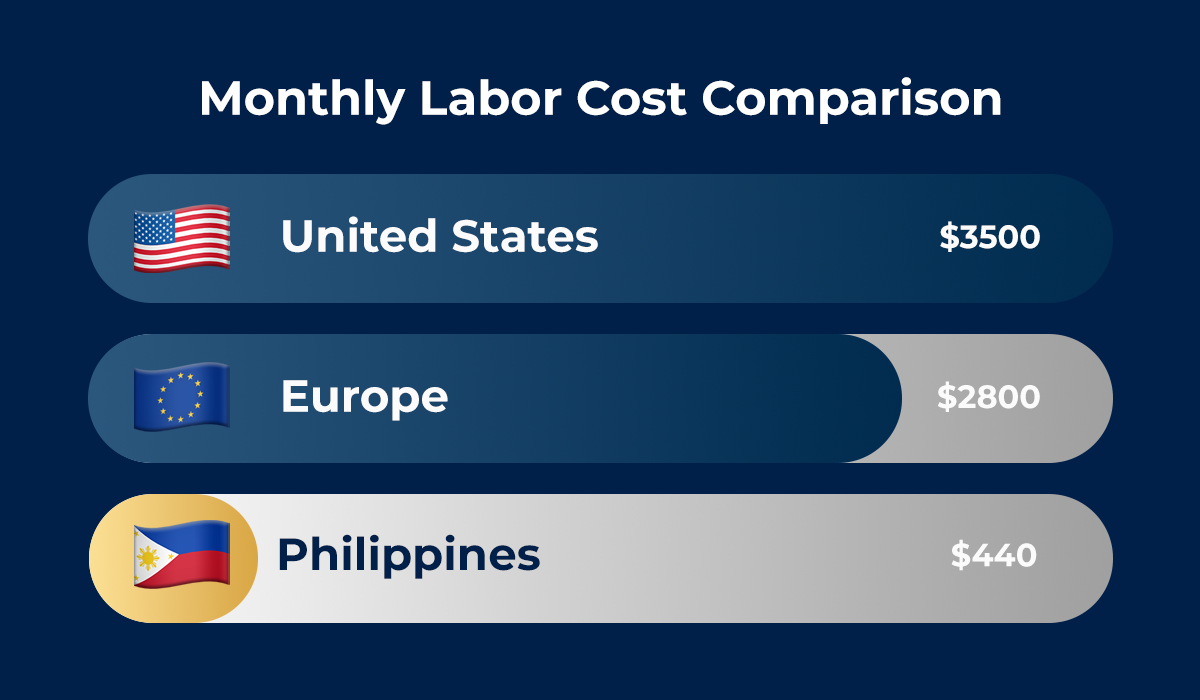
Aside from that, you also reduce operating expenses because running operations in the Philippines is also lower because of the cost of living.
In short, scaling your business and reducing overhead costs is easier when you outsource to the Philippines.
And the lower costs don’t mean subpar service either, because Filipinos have…
Excellent English-Speaking Abilities
Anyone familiar with outsourcing knows that Filipinos have high English fluency. Case in point: on the 2025 EF English Proficiency Index, the Philippines is second only to Malaysia as the top Asian country that’s well-versed in English.
You can find someone who speaks English no matter where you go in the country.
Many factors contribute to this.
For one, schools in the Philippines teach almost all subjects in English. Books and other educational materials, street and store signs, maps, you name it–are all in English, too.
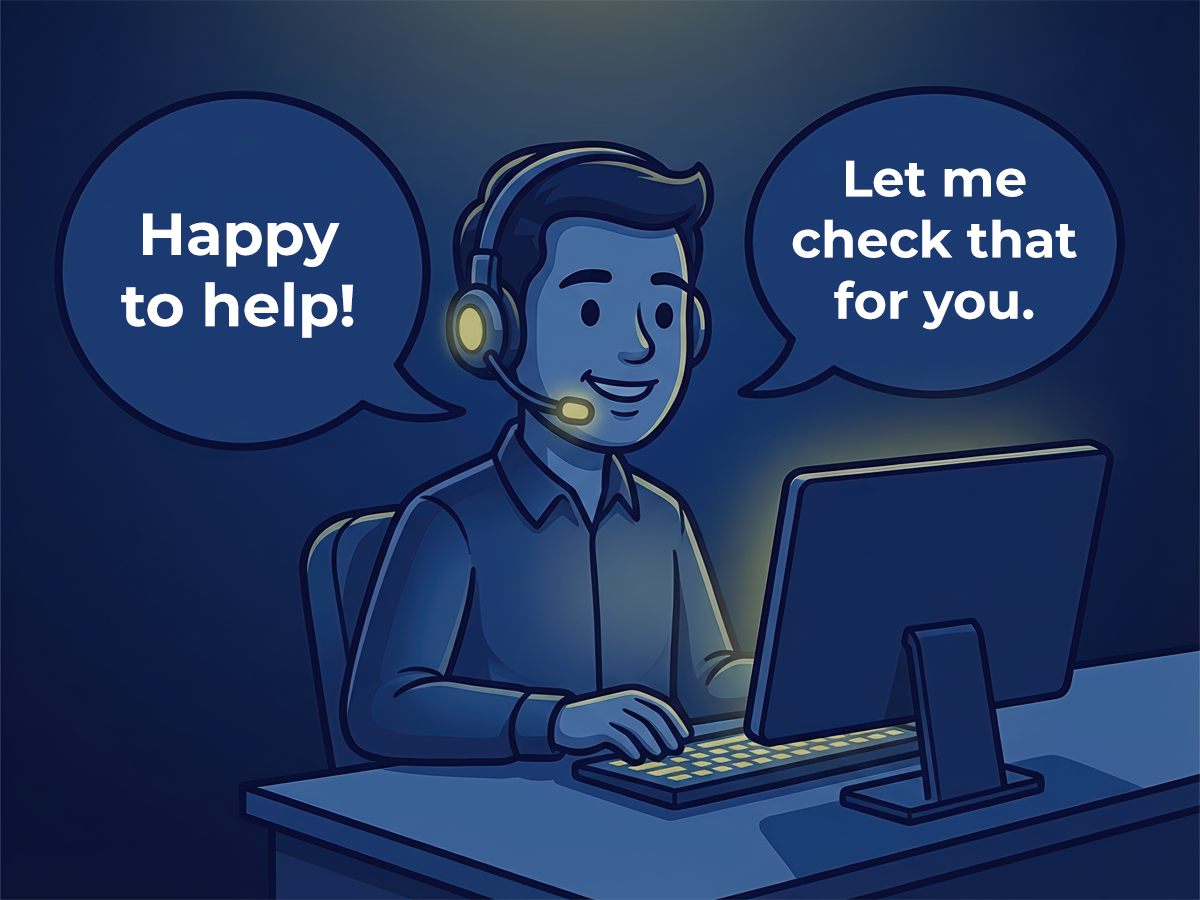
Filipinos are also great at conversational and written English, which leads to fewer lost-in-translation moments between customer and support teams.
Written English proficiency also means they can work well asynchronously with off-site teams without misunderstanding or needing to hop on a call to communicate effectively.
Filipinos can fit into your existing team and serve customers better for these reasons.
On top of that, their accents tend to be more neutral compared to those of other Asian countries.
And the advantage goes further than language.
American Influence
The Philippines and the US are, to put it simply, friends who have a lot of history.
The US occupied the Philippines for a time, and eventually, they became allies. The ties are so strong that many Filipinos migrated to the US and call it a second home.
America also contributed to the country’s development by establishing the country’s first public education system.
Naturally, Filipinos have developed a huge fascination with American and Western culture.
They are in the know when it comes to American pop culture, movies, and even celebrity news.
They understand the nuances of American life, cultural references, history, and pop culture through early exposure to them in local media and formal education.

This also means that working closely with American clients is a breeze for them because Filipinos have a natural affinity for Western culture, on top of their high English proficiency.
This ability crosses over to customer experience because Filipino agents can communicate on a deeper level by understanding nuances and matching tone. They don’t have to be as scripted in their interactions.
Work Ethic and Hospitality-Centric Attitudes
Aside from English fluency, Filipinos are known for their work ethic and service-oriented mindset.
Hospitality is a prized trait in Filipino culture. Being aware of other people’s needs translates well to jobs like customer support.
They also tend to work hard as they take pride in their work and want to please their employers and customers.
This combination means Filipinos make for a dedicated workforce.
BPO-Supportive Government Policies
BPO is a huge income source not just for Filipinos but for their economy as a whole. The Philippine government knows that labor is its biggest asset and thus has invested heavily in the local BPO industry. They’ve made sure that companies can easily set up business in the country.
Aside from the Special Economic Zone Act of 1995, the government has passed policies to deregulate telecommunication companies, given tax exemptions, upgraded infrastructure, and prioritized data privacy, all in a bid to make the country an outsourcing destination.
The Philippines has a strong regulatory environment, and with initiatives like the IT-BPM Roadmap 2028 and the Digital Cities 2025 Program, you can expect even more from BPOs in the Philippines.
24/7 Availability
Philippine teams can work in any timezone and can even fully align with US timezones. Employees are used to working night shifts and can provide 24/7 coverage for clients.
Companies support this follow-the-sun availability by paying for transport, night differentials, and even meals for their employees during the workday.
Those on the daytime shifts also ensure that your customers have after-hours support while your onshore team sleeps.
Data Protection and Privacy Laws
In an age of security breaches and data leaks, privacy is a non-negotiable when outsourcing.
The Philippines knows that data privacy and cybersecurity must be prioritized if it wants to grow its BPO industry. The country takes privacy seriously and has created robust laws that protect consumers’ personal data.
For example, the Philippine Data Privacy Act (DPA) of 2012 was actually initiated as a response to the growth of the BPO industry.
The law follows global standards of data privacy protection to prevent security breaches, identity theft, and other misuse of protected personal information.
The takeaway: you are in good hands when you outsource tasks to a Philippine provider, as long as they follow best practices and security protocols.
Cons of Outsourcing to the Philippines
Filipino Culture and Family Values

The Philippines, staying true to Asian culture, puts family first. That’s not a bad thing. However, their definition of family is all-encompassing. We’re talking extended family like aunts, uncles, cousins, etc.
What does this mean for companies? Family obligations are very important. Sometimes, family is prioritized at the expense of the individual.
For example, people may occasionally miss work to take care of a sick relative. They may be supporting or living with multiple generations of their family.
Companies also have to consider including their employees’ families when throwing work parties and out-of-town team-building events. The boundary between work and family in occasions like these is more permeable.
Ethos Support recognizes the role of family in our agents’ lives. We cover healthcare, promote work-life balance, and have open communication so any issues, personal or professional, are addressed.
Taking care of our employees so they can also take care of their families means agents stick with us for the long haul.
Managing an Offshore Team Digitally
As with all offshore teams, some BPOs find it challenging to handle people remotely, especially if schedules are asynchronous. Some companies without remote experience are more used to building rapport through in-person conversations.

There might be communication delays and collaboration challenges because of the lack of a shared office.
These challenges aren’t unique to Philippine outsourced workers, but they nonetheless still exist and are things to consider before hiring.
Ethos Support’s leadership has a combined 100 plus years of experience in remote work operations, and they bring that shared expertise in how we handle clients and train our globally-distributed staff. Work from home isn’t a hindrance; it’s a modern reality that we welcome.
Labor Law Considerations
When hiring from other countries, you have to comply with their labor laws. The Philippines is no exception.
These are just some of the minimum terms, conditions, and benefits a company has to provide its Filipino employees:
- An eight-hour workday with a 60-minute break
- Overtime pay for work that exceeds 8 hours per day or work that falls on a holiday or rest day
- Night differential pay for work hours between 10 PM and 6 AM
- At least 24 hours of consecutive rest period for every six consecutive work days
- Pay that is not less than the minimum wage
- 13th-month pay
- Paternal leave, maternal leave, and parental leave for solo parents
These benefits don’t apply to independent contractors, though. However, you will most likely have to deal with these requirements if you outsource a full-blown team.
The right outsourcing partner can take care of dotting the i’s and crossing the t’s for you so you remain compliant with local laws. Reach out to our team at Ethos Support if you’re looking to hire globally and we’ll be happy to assist you.
Slower Internet Connectivity
Though 97.5M Filipinos use the internet (and they also rank number one in daily internet usage globally), internet speed in the Philippines leaves much to be desired.
In terms of mobile broadband rankings, the Philippines placed 63rd out of 102 countries. Median fixed broadband download speeds were at 94.42 Mbps in Q2 2024.
Geography is one reason for this issue. Since the Philippines is an archipelago, building a high-speed broadband infrastructure is challenging.
However, broadband speeds are getting better. Even the government is investing in projects that will enhance internet infrastructure.
These initiatives will hopefully allow the Philippines to catch up with its Asian peers.
Ethos Support uses only the most reliable internet service providers, dramatically reducing the chances of internet connectivity issues. Our Philippines-based members are evenly distributed throughout the country, ensuring that we have an uptime of 100 percent.
Our infrastructure has accounted for internet connection hiccups and has built-in redundancies, so each client is taken care of no matter what.
Calamities and Power Outages
The Philippines’ location makes it prone to natural disasters like typhoons and tropical cyclones, as well as earthquakes and (less common) volcanic eruptions.
For BPOs, this means workers can be hit with floods and landslides that prevent them from going onsite or even online. Power outages affect less urbanized areas in the country (this is less of a problem in cities like Metro Manila and Cebu).
When calamities happen, it can put operations to a halt while everyone gets back on their feet.
Ethos Support’s vast and distributed network of agents ensures that no matter what region is affected by a calamity, other agents can fill in and continue to serve our clients. You never have to worry if an agent calls out because we train a roster agents so that no matter what happens, someone is ready to go for your brand, twenty-four hours a day.
We also make sure to take care of our team members in need so they can recover quickly from calamities and power disruptions.
Attrition
Attrition rates are higher in BPO companies in the Philippines. Attrition is estimated to be at 40 to 45 percent in call centers, a rate that is double that of other industries.
It’s a very real issue that eats into recruitment and training costs for both the company and clients.
As we know, replacing an agent has a ripple effect on an organization. It means a company might become undermanned, which leads to longer turnaround times, more customer complaints, and higher chances of burnout on the team members left behind.
This is why we emphasize employee experience at Ethos Support. We believe that to create a great customer experience, you need to take care of your employees first. The customer experience follows naturally from there.
And the proof is in the pudding: Ethos Support has a less-than-5-percent attrition rate, a big feat in the churn-heavy BPO industry.
Hidden Fees
Before you commit to an outsourcing provider in the Philippines, you have to do due diligence and read the fine print.
The cost of hidden fees adds up fast and may surprise you. What looks like incredible savings might be false advertising because of things like:
- High initial recruitment fees
- Setup fees
- Additional recruitment fees for screening, background checks, and posting on job boards
- Fees for scope changes
- Off-hours premiums
- Government fines for miscalculations of government-mandated pay (overtime, 13th-month, or holiday pay)
- Backup power supply and internet redundancy costs
- Training costs (onboarding, special certifications or skills training, online courses)
- Licensing, cybersecurity, and other tools
- HR, admin, and payroll staff
Your BPO partner, in an ideal world, will walk you through these details and what is and isn’t covered by your contract.
However, that’s not always the case, so make sure to vet outsourcing providers thoroughly and ask a lot of questions.
Here at Ethos Support, we pride ourselves on honesty. We are transparent about pricing and will even adapt services to suit your budget.
You can scale up or down as your needs change. You’re not locked into one plan forever.
To learn more, contact us here for a free consultation.
How to Choose the Right Business Process Outsourcing Provider in the Philippines
Not sure where to start with outsourcing? Selecting the right BPO company to partner with can help a lot with navigating the Philippine market.
Here are some guidelines for finding the right outsourcing match for you.
- Determine what tasks you want to outsource, your budget, and your must-haves in a BPO provider.
- Ask for a cost breakdown and check for hidden fees. Flexible contracts are a plus in case your needs change.
- Compare prices of different providers, but don’t get hung up on price alone.
- Ask how the provider trains their talent and how they plan to tailor their voice to your company’s brand.
- Ask how they plan to safeguard your data and prevent breaches.
- Check reviews and past clients.
- Define what success looks like for you and what your KPIs are.
- Ask how your provider prefers to communicate and how they handle cultural differences.
Outsourcing to the Philippines: The Bottomline
Outsourcing to the Philippines has earned its reputation for a reason.
The country has built an ecosystem around service work that combines English fluency, cultural alignment with Western markets, and a workforce that genuinely values hospitality. Those advantages are real.
But like any outsourcing decision, success depends far less on the country itself and far more on the partner you choose.
The challenges we outlined above, such as attrition, operational transparency, and remote team management, are not inevitable outcomes of outsourcing. More often, they are symptoms of how a provider structures its teams, communicates with clients, and invests in its people.
That is where the right partner makes all the difference.
At Ethos Support, our model focuses on building stable, long-term teams rather than high-churn call center environments.
As a global outsourcing provider, we emphasize transparent pricing, clear operational alignment with our clients, and ongoing investment in the agents who represent their brands.
Instead of locking companies into rigid plans or oversized teams, we build support structures around what the business actually needs. That could mean starting with a single agent or scaling to a full team over time.
And no matter what country you’re interested in hiring from, we can deliver a custom team personalized to you and who know your company’s values, mission, and tone by heart.
The Philippines remains one of the best places in the world to build customer support and operational teams. With the right partner and the right expectations, it can become a powerful extension of your business.
If you’re exploring outsourcing in the Philippines (or anywhere else in the world) and want to understand what a transparent, people-focused model looks like, Ethos Support is always happy to have that conversation.
FAQs
Why is the Philippines a popular outsourcing destination?
The Philippines offers a unique combination of high English proficiency, lower labor costs, and a service-oriented culture that makes it ideal for customer-facing roles. The government also supports the BPO industry with favorable policies and infrastructure investments.
What services are commonly outsourced to the Philippines?
Companies typically outsource customer support, technical assistance, finance and accounting, sales and lead generation, administrative tasks, and back-office operations to the Philippines. Chat and email support, human resources, and travel management are also popular services.
How do I manage an outsourced team in the Philippines?
Establish clear communication channels and schedule regular check-ins that work across time zones to maintain alignment and build rapport. Set measurable performance goals and use collaboration tools to stay connected with your team despite the distance.